G7 to Release Up to 100 Million Barrels of Oil From Reserves to Lower Prices
Darwin, October 3: Under pressure from US President Donald Trump to bring down rising fuel prices, G7 leaders are set to release up to 100…



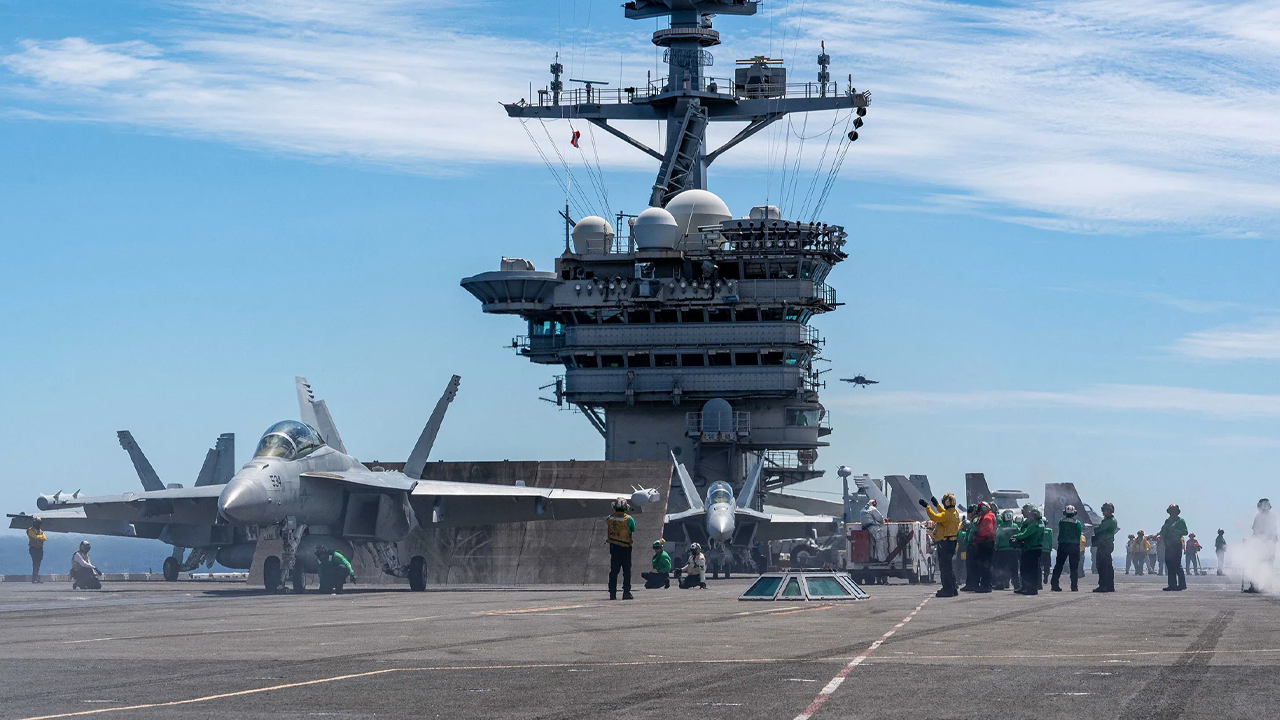
Darwin, October 3: As the Iran war enters its eighth month, the United States is sending a third aircraft carrier strike group to waters near Iran in the Middle East. At the same time, several thousand more US troops are being deployed to the region, according to a US official who spoke to Al Jazeera.
The deployment comes one month before the US midterm elections in November. Amid widespread discontent in the United States over the war, there are concerns that its impact could be felt by President Donald Trump’s Republican Party.
According to the US official, the USS Theodore Roosevelt carrier strike group left its base in San Diego, California, on Sunday and headed toward the Middle East. A day later, the US Marine Corps’ Island Marine Expeditionary Unit (MEU) also departed. It includes more than 2,000 Marines.
The Wall Street Journal reported that the new carrier strike group and other naval deployments could add a total of 9,000 to 10,000 US personnel to the region. This figure includes sailors and Marines aboard the aircraft carrier and other vessels.
The US official said that by the end of November, three aircraft carriers and two amphibious assault units would be positioned near Iran.
According to the official, concentrating such a large military force in one area would give Trump a wider range of options if he decides that military action is necessary.
Al Jazeera correspondent Tania Nouri, reporting from Washington, said the new deployment also includes F-35 fighter jets. This would add further military strength to the approximately 50,000 US troops already stationed in the Middle East.
Citing sources at the Pentagon and the White House, Nouri said that regardless of how diplomatic negotiations progress, one of the main objectives of the new deployment is to keep the option of military action on the table for Trump. Even if the United States reaches an agreement with Iran, the Pentagon currently has no plans to withdraw the military assets.
US Defense Secretary Pete Hegseth has also said that American forces are prepared to move if Trump orders another attack.
The United States has maintained troops and military equipment at various bases across the Middle East for decades. According to the Council on Foreign Relations, the US has an extensive network of permanent and temporary military facilities at at least 19 locations in the region. These include eight permanent bases in Bahrain, Egypt, Iraq, Jordan, Kuwait, Qatar, Saudi Arabia and the United Arab Emirates.
The first US troop deployment to the Middle East took place in July 1958. American troops were sent to Beirut during the Lebanon crisis. At its peak, approximately 15,000 Marines and soldiers were stationed in Lebanon at the time.
By mid-2025, around 40,000 to 50,000 US troops were stationed in the Middle East. Some were deployed at large permanent bases, while others were positioned at smaller forward military installations.
Trump has been increasing the US military presence in the Middle East since the beginning of this year. Early on, various warships, including the USS Abraham Lincoln aircraft carrier, were sent to the Arabian Sea.
According to open-source intelligence analysts and military flight-tracking data, more than 120 US military aircraft have been deployed to the Middle East since early February. Analysts say this is the largest concentration of US air power in the region since the 2003 Iraq War.
The aircraft deployed include E-3 Sentry Airborne Warning and Control System (AWACS) aircraft, F-35 stealth fighter jets, F-22 air-superiority fighters, and F-15 and F-16 fighter jets.
According to flight-tracking data, many of these aircraft flew from bases in the United States and Europe. Cargo aircraft and aerial refueling tankers have also been deployed. Military analysts say this indicates preparations for a prolonged military operation rather than routine troop rotations.
In March, the Pentagon ordered additional US troops to be sent to the Gulf region. The first deployment involved the Tripoli Amphibious Ready Group, centered around the USS Tripoli, and the 31st Marine Expeditionary Unit.
The second involved the Boxer Amphibious Ready Group, centered around the USS Boxer, and the 11th Marine Expeditionary Unit. Together, the two units added another 4,500 Marines and sailors to the region.
A third unit, consisting of approximately 2,000 soldiers from the 82nd Airborne Division at Fort Bragg, North Carolina, was also deployed. The unit is primarily trained to conduct rapid operations using parachute assaults.
Overall, approximately 7,000 additional US troops have already been deployed to the Middle East since the Iran war began.
It remains unclear whether the new troop deployment signals a further escalation of the war. However, in an interview with Time magazine published on Thursday, Trump indicated that there could be an expansion of bombing operations against Iran after the midterm elections.
Asked for more details, Trump said, “I can’t tell you that. Because you’re asking where you’re going to bomb, right?”
Some analysts believe that deploying additional troops could also be part of Washington’s negotiating strategy to increase military pressure on Iran.
Last week, Iran submitted a new proposal to reopen the Strait of Hormuz within seven days. However, Tehran said that this would require the United States to meet several conditions, including lifting sanctions, releasing Iranian assets that have been frozen, and providing guarantees that attacks would cease.
The Trump administration rejected the proposal. Analysts say the United States wants to include additional issues in negotiations, such as Iran’s nuclear program.
In an interview with Time magazine, Trump said he had rejected Iran’s latest ceasefire proposal because it contained conditions that he would not have accepted a year ago and still would not accept today.
Alongside its display of military power, Washington has also increased economic pressure on Iran. Earlier this week, the US Treasury Department imposed sanctions on major Iranian companies in the railway and automotive industries. According to the department, the new measures are aimed at drying up Tehran’s remaining sources of revenue.
Last month, the United States also announced sweeping sanctions targeting Iran and other countries conducting trade with Tehran.
Source: Al Jazeera

Darwin, October 3: Under pressure from US President Donald Trump to bring down rising fuel prices, G7 leaders are set to release up to 100…
Darwin, October 3: Russia’s daily attacks are filling the lives of Kyiv residents with fear and uncertainty. From schools and hospitals to bridges, power plants…
Darwin, October 3: At least 80 fighters have been killed over the past 24 hours in fierce fighting between Iran-backed Houthi rebels and Saudi-backed government…
Darwin, September 30 : The United States is preparing to withdraw its military forces from Iraq after more than two decades of war and the…
Darwin, September 30: Russia has urged Iran not to withdraw from the Treaty on the Non-Proliferation of Nuclear Weapons (NPT), calling on Tehran to remain…
Darwin, September 30: Russia currently lacks sufficient military capability to launch a major attack against NATO because its forces are engaged in the war in…
Four personnel of India’s Central Industrial Security Force (CISF), including an officer, were killed after a colleague allegedly opened fire on them at a hydropower…

Darwin, September 25: The Netherlands is seeking to build an international coalition to evacuate at least 1,000 sick and injured children from Gaza for medical treatment,…