Houthi Activity Around Bab al-Mandab Raises Fears of Major War
Darwin, September 11 : The ongoing conflict in Yemen could escalate into a major new war, as Iran-backed Houthi forces are allegedly advancing to seize…



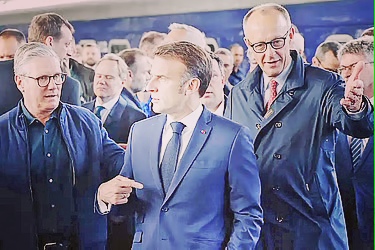
Darwin, 14 May : The growing tendency among European leaders to publicly criticize Donald Trump can no longer be viewed as the result of any single incident.
Rather, it signals a broader shift in which Europe is gradually moving away from its previously dependent and deferential stance toward the United States and adopting a more assertive and self-confident position.
When German Chancellor criticized Trump last month, it was not merely a personal opinion or a reflection of temporary tensions between Berlin and the White House. Instead, it reflected a wider mindset among European leaders, who are now prepared to speak directly against the Trump administration on critical issues such as Iran, Ukraine, and European sovereignty.
One major reason behind this shift is the increasingly unpredictable and volatile policies of the Trump administration. Many European leaders believe stronger responses have become necessary in the face of such policies.
Commenting on Trump’s stance regarding the Iran war, Merz said during an event at a school in his constituency that Trump had no effective exit strategy and that Iran’s diplomatic maneuvering had instead “humiliated” the United States.
But Merz is not alone. Leaders such as French President , British Prime Minister , and Italian Prime Minister have also made increasingly tough remarks in recent months.
Earlier this year, the United States’ attempt to acquire was seen by Europe as clearly unacceptable.
It was viewed as a violation of the territorial integrity of a NATO ally and a denial of the Greenlandic people’s right to self-determination. Similarly, Trump and his ally were accused of trying to help Hungarian leader during Hungary’s elections, which also triggered backlash across Europe.
Yet these incidents alone do not explain the change. More importantly, a growing belief has emerged in European capitals that American influence is no longer as dominant as it once was.
The Iran war has made this reality even clearer. To project military power in the Middle East, the United States still depends heavily on military bases located in Europe. This means dependence is no longer one-sided; Europe also holds significant leverage.
At the same time, Europe has substantially increased its own military spending, with a growing share of that investment now going to European arms manufacturers. Although the United States remains Europe’s largest weapons supplier, the balance is slowly shifting.
According to the Stockholm International Peace Research Institute (SIPRI), the U.S. share of arms exports to Europe fell from 64 percent to 58 percent between 2021 and 2025.
This shift is also evident regarding Ukraine.
Since March 2025, the United States has stopped providing financial aid to Kyiv, meaning most of Ukraine’s funding now comes from the European Union. Ukraine still purchases weapons according to NATO standards, but a large portion now comes from outside the United States. Nearly 60 percent of its military equipment is domestically produced, while another 20 percent comes from Europe.
European governments are also beginning to realize that many of Trump’s threats ultimately go unfulfilled. Opposition within the U.S. Congress, the courts, and even Trump’s own political camp has continued to grow.
After the failure of Trump and Vance’s intervention efforts in Hungary, concerns about the influence of the “MAGA” movement in Europe have also eased. In fact, because Trump remains unpopular among many European voters, taking a firm stance against him has boosted the political standing of several European leaders.
This changing mindset is also expected to shape future trade disputes. If Trump raises tariffs on European products such as cars, Europe is unlikely to respond as softly as before. European Union member states have already approved potential retaliatory measures targeting nearly €93 billion worth of American goods, although negotiations will initially remain open.
Overall, the relationship between the United States and Europe is changing. Europe is no longer as submissive as it once was. Many European leaders now believe they possess the strength to resist American pressure.
Writer: . Adapted from .

Darwin, September 11 : The ongoing conflict in Yemen could escalate into a major new war, as Iran-backed Houthi forces are allegedly advancing to seize…

Darwin, September 11 : Israel’s National Security Council (NSC) has warned of an increased risk of terrorist attacks against Israeli citizens and Jews in various…

Darwin, 11 September : Missiles fired by an “enemy” struck several areas of Sirik in southern Iran, the country’s state media reported. Al Jazeera reported…

Darwin, September 8: Precious metal prices declined in the international market on Tuesday. In the spot market, silver prices fell 0.5% to $65.76 per ounce….
Darwin, Septermber 08 : At least 73 civilians, including women and children, have been injured in attacks by Yemen’s Houthi rebels targeting civilian and economic…

Darwin, 08 September : Ukraine has taken steps toward legalizing pornography as a way to raise funds for its war with Russia. According to The…
Darwin, September 07: Iran is preparing for a major, multi-front attack against Israel, according to an Israeli intelligence assessment. The report says Iran is seeking…

Darwin, 07 September: Air travel in Indonesia has been disrupted by ash from the eruption of Anak Krakatau volcano. As of Monday morning, seven airports,…