Darwin, 21 July : New Delhi is facing mounting political and social pressure as two separate waves of protests unfold simultaneously. On one side, farmers from Punjab and Haryana have revived their “Delhi Chalo” campaign to safeguard India’s agriculture and rural economy. On the other, young activists and members of civil society associated with the unconventional Cockroach Janata Party continue demonstrations against government policies and administrative practices.
Farmers Stopped at Shambhu Border
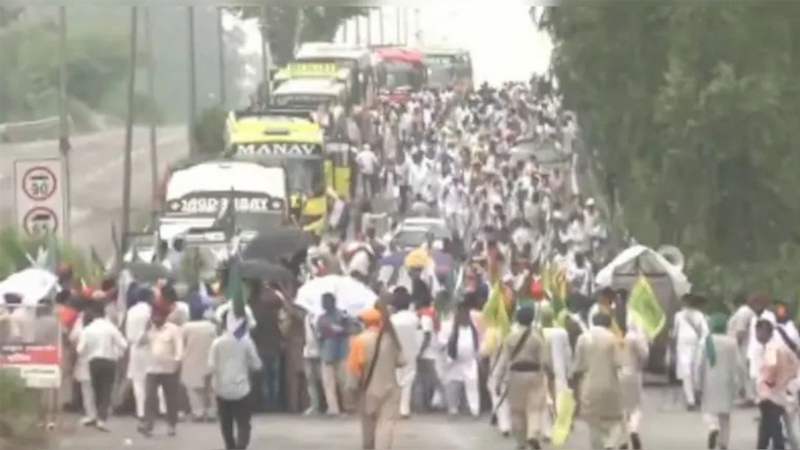
Hundreds of farmers from Punjab were once again stopped at the Shambhu border between Punjab and Haryana on Tuesday while travelling to New Delhi to participate in the Kisan Mahapanchayat, organized in protest against the proposed India–United States comprehensive bilateral trade agreement.
The scene echoed the “Delhi Chalo 2” movement of February 2024. To prevent protesters from entering the capital, Haryana Police erected multiple layers of barricades, including concrete blocks, iron spikes, and reinforced security barriers, effectively turning the border crossing into a fortified checkpoint.
Border Becomes Protest Site
Unable to proceed to Delhi, the farmers have turned the Shambhu border into an indefinite protest site. Farmer leaders accused both the Punjab and Haryana governments of suppressing their democratic right to assemble and protest peacefully.
Tejbir Singh, a leader of Bharatiya Kisan Union (Shaheed Bhagat Singh faction), alleged that Haryana Police had illegally entered Punjab territory to install barricades, while accusing the Punjab government of remaining a “silent spectator.”
Despite the blockade, farmers from Haryana districts including Ambala, Kurukshetra, and nearby areas have continued their journey toward Delhi.
Why Are Farmers Protesting?
The protest has been organized under the banner of Desh Bachao Morcha, a coalition of farmer organizations from Punjab, Haryana, and Himachal Pradesh.
Sarwan Singh Pandher, a leader of the Kisan Mazdoor Sangharsh Committee (KMSC), said that a joint India–U.S. statement released in February 2026 indicated that the first phase of the proposed bilateral trade agreement would be finalized by the autumn of 2026.
Farmer organizations argue that the proposed deal extends far beyond conventional trade. According to them, it includes sensitive sectors such as agriculture, dairy, manufacturing, digital trade, e-commerce, intellectual property rights, and services.
Concerns Over Small Farmers
Farmer groups fear that reducing tariffs on American agricultural products—including soybeans, corn, cotton, apples, almonds, dairy products, and poultry—would expose Indian farmers to unfair competition.
They argue that U.S. farmers receive substantial government subsidies, allowing American products to enter the Indian market at significantly lower prices. As a result, millions of India’s small and marginal farmers could struggle to compete and face severe financial hardship.
The dairy sector is another major concern. Farmer organizations estimate that nearly 80 million rural families depend directly or indirectly on dairy-related livelihoods. They warn that increased imports could disrupt the rural economy, affecting small businesses and the food-processing industry.
Demand for Transparency
Alleging that negotiations over the trade agreement have been conducted without adequate transparency, the Desh Bachao Morcha has demanded that the central government immediately make all documents related to the proposed India–U.S. trade agreement public.
The coalition has also insisted that no agreement should be signed with the United States without extensive consultation and consent from farmers, dairy producers, workers, and other key stakeholders. According to the protesting groups, any deal affecting India’s agricultural sector must be subject to public scrutiny before it is finalized.