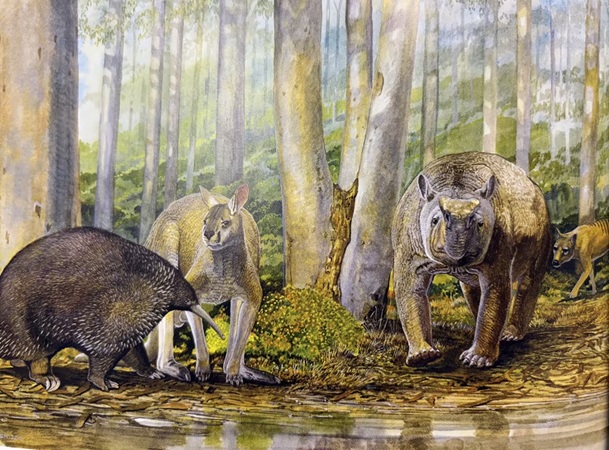
SYDNEY, AUSTRALIA – A long-standing theory that Australia’s First Peoples hunted the continent’s colossal megafauna to extinction is being radically challenged by new research. A detailed analysis of two 50,000-year-old fossils suggests that early Indigenous Australians valued the bones of these extinct giant animals as collectibles, trading them over vast distances, rather than using them primarily for meat.
The findings, published Wednesday in the journal Royal Society Open Science, cast doubt on the primary piece of “hard evidence” supporting the human-driven extinction hypothesis, redirecting the focus toward climate change as the likely cause of the megafauna’s disappearance.
For decades, a fossilized tibia (lower leg bone) of an extinct giant kangaroo, discovered in Mammoth Cave in southwestern Australia, was considered the “smoking gun.” The bone contained a distinct cut mark, which scientists in the 1960s and 80s interpreted as proof that First Peoples butchered the ancient animals.
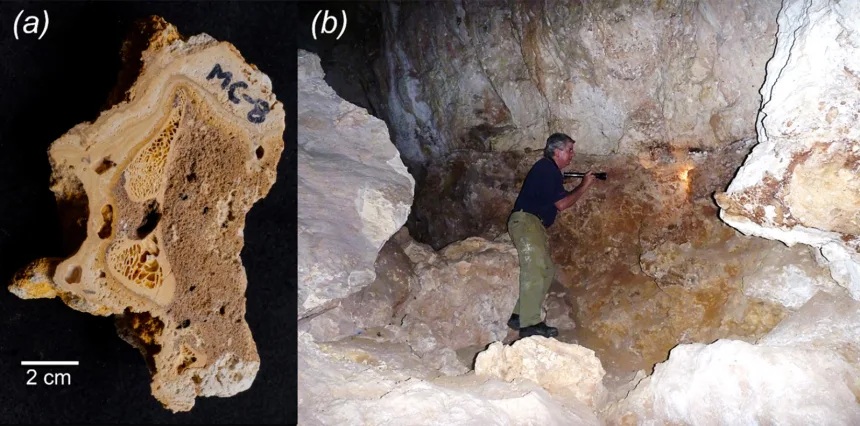
Mineral deposits coat a fossil bone (left) from an excavation site in Mammoth Cave. The late Lindsay Hatcher (right), a study coauthor, indicates where the sample was obtained.(Jon Woodhead)
However, lead author Dr. Michael Archer, a professor and researcher at the University of New South Wales (UNSW), and his team re-examined the fossil using a micro-CT scan—a sophisticated, non-destructive 3D imaging technique.
The scan revealed a surprising truth: the cut was made after the bone had already dried out and developed shrinkage cracks, indicating it was long dead—and likely already fossilized—when the incision occurred. This new interpretation rules out butchering, suggesting instead that the mark was part of an effort to collect the preserved bone.
“The evidence clearly indicated the cut had occurred on the bone only after the bone had already become a fossil,” Dr. Archer said. “The cut was part of an effort to collect the fossilised bone as a curiosity by First Nations People — they were fossil collectors, just like us!”
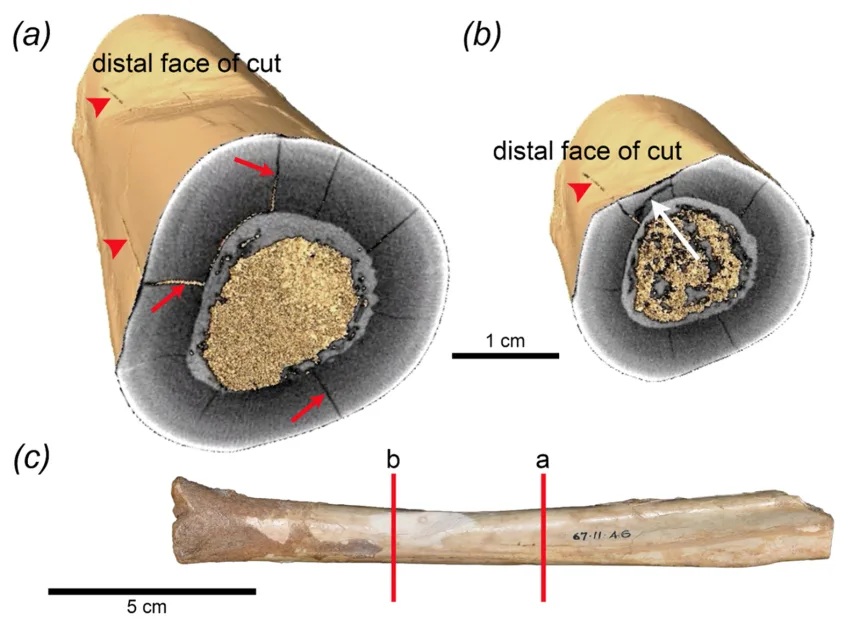
In cross sections of the Mammoth Cave tibia, red arrows (a) indicate three longitudinal cracks. In another cross section, a white arrow (b) shows a transverse crack. Two red lines (c) indicate the approximate positions of the cross sections. (Blake Dickson)
The researchers bolstered their new theory by examining a second, equally intriguing fossil: a premolar tooth from the extinct giant wombat, Zygomaturus trilobus. The tooth was gifted to an anthropologist in the late 1960s by an Indigenous man in northern Australia, where the species is not known to have lived.
The tooth was kept as a cultural charm, mounted in resin and attached to a string made of human hair. Dr. Archer noted that for the tooth to end up in the northern Kimberley region, it was “probable… that it had been collected as a fossil in the southwest of Western Australia and then traded up the coast.”
The study challenges the long-standing assumption—rooted in what Dr. Archer describes as “Western biases” established by centuries of European-caused extinctions—that Indigenous Australians were responsible for the “over-killing” of megafauna like the 10-foot-tall short-faced kangaroos and rhino-sized marsupials.
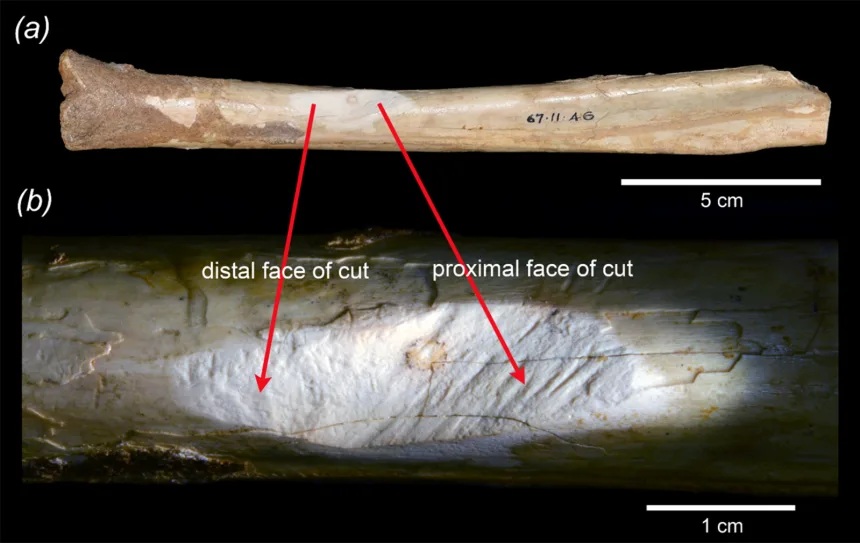
The tibia (a) from Mammoth Cave with the incision (b) on the shaft. (Anna Gillespie)
Instead, the findings suggest humans and megafauna coexisted for at least 15,000 years before their disappearance around 46,000 years ago.
“There is currently no hard evidence that extinct megafaunal animals in Australia were butchered by First Peoples,” Dr. Archer stated. He concludes that climate variability, rather than human hunting, likely led to the progressive extinction of Australia’s largest animals.
Archaeologist Dr. Judith Field, who was not involved in the study, agreed, noting that the new research “adds another interesting facet to our wealth of knowledge of the complexities of human behaviour,” which has long included the collection of bones and shells as cultural objects.