Pakistan Says ‘Final and Consensus’ U.S.-Iran Ceasefire Draft Near Completion
Darwin, 13 June : Pakistani Prime Minister has announced that a “final and consensus-based” ceasefire draft agreement has been prepared to ease ongoing tensions between…



Darwin, 20 November –
Ukraine is entering what may be the most dangerous phase of its war with Russia. After years of conflict, the country’s military manpower and equipment are steadily running out. Even more alarming, Ukrainian forces in several critical areas—including Pokrovsk and Zaporizhzhia—have become encircled by advancing Russian units. Meanwhile, Moscow continues to exploit the situation by striking key Ukrainian infrastructure, pushing the country’s essential services closer to systemic collapse.
Western intelligence agencies now appear to recognize the gravity of the situation. Ukraine’s prospects on the battlefield look increasingly bleak, and questions are rising about how long its armed forces can survive as a coherent, coordinated structure. High casualty rates and widespread desertion have become an open secret, shared and suffered by ordinary Ukrainians paying the price of a prolonged war.
At the same time, Ukraine is allegedly using its hyperactive intelligence networks to provoke incidents across Europe. Western analysts believe these efforts are aimed at widening the conflict in hopes of forcing greater Western and NATO involvement to ensure the survival of the Ukrainian government.
Two recent events seem to illustrate this volatility.
1. The Warsaw–Lublin Railway Explosion
The first is the bomb explosion on the Warsaw–Lublin railway line, a crucial route for transporting Western military supplies to Ukraine. Poland initially blamed Russia, calling the incident a “sabotage operation.” But Polish Prime Minister Donald Tusk later dramatically shifted this narrative. After a highly publicized visit to the site, he claimed Ukrainian operatives—allegedly with help from Russian intelligence—were behind the incident. Whether Tusk can substantiate this unusual allegation remains to be seen.
2. Alleged Plot to Assassinate Sergei Shoigu
The second incident involves a claim by Russia’s FSB that it thwarted a Ukrainian plot to assassinate Sergei Shoigu—the current secretary of Russia’s Security Council and the country’s defense minister from 2012 to 2024. The Russian newspaper Moskovsky Komsomolets published details of the alleged plan.
Questions also surround an attempted attack on Hungary’s largest oil refinery at Százhalombatta. The pipeline had previously been targeted by Ukraine. Additionally, unidentified drones have repeatedly been spotted near military facilities, weapons plants, and bases across Europe. Although European governments typically attribute these sightings to Russia, Poland’s recent revelations suggest that some incidents may have originated from Ukrainian provocations.
The logic behind such actions is straightforward: Ukraine’s chances of holding out militarily are diminishing rapidly. The country may be attempting to push NATO into direct involvement to prevent a total collapse.
Is NATO Prepared to Intervene?
But NATO appears far from ready for large-scale intervention. The alliance lacks sufficient weapons stockpiles, has limited deployable ground forces suited for Ukraine’s battlefields, and remains short on essential drones and advanced combat systems. Ukraine’s own forces are nearly exhausted, whereas Russia is believed to have around 700,000 troops committed to the war. Under such circumstances, a handful of NATO brigades would be insufficient to alter the course of the conflict.
While NATO retains air superiority through its advanced fighter aircraft, Russia’s layered air-defense systems pose a formidable challenge to any potential aerial campaign.

Darwin, 13 June : Pakistani Prime Minister has announced that a “final and consensus-based” ceasefire draft agreement has been prepared to ease ongoing tensions between…

Belfast, Northern Ireland — Civil unrest in Belfast has taken a more organized and alarming turn as coordinated digital tracking tactics have reportedly been used…

Darwin, 12 June : The United Kingdom, Australia, and Canada on Thursday announced an “International Fund for Peace” for Israelis and Palestinians, aimed at supporting…
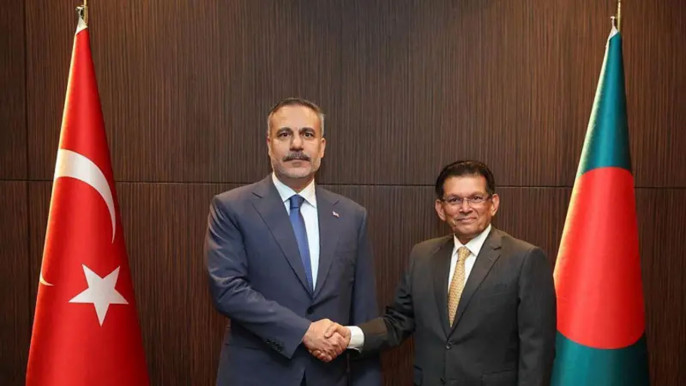
Darwin, 12 June : Turkey’s proposal to strengthen cooperation with Bangladesh in the defense industry, raised during Turkish Foreign Minister Hakan Fidan’s visit to Dhaka,…

Darwin, 11 June : Three Indian sailors have been confirmed dead after a U.S. missile strike hit an oil tanker near Oman’s coast in the…
Darwin, 11 June : The United States has launched a new wave of military strikes against Iran, escalating tensions in an already volatile regional conflict….
Darwin, 10 June : In the early hours of Wednesday, the U.S. military carried out strikes in Iran following the downing of a U.S. Apache…

Darwin, 10 june: Washington has rejected Israel’s claim that the United States took part in intercepting ballistic missiles launched from Iran toward Israel. A U.S….