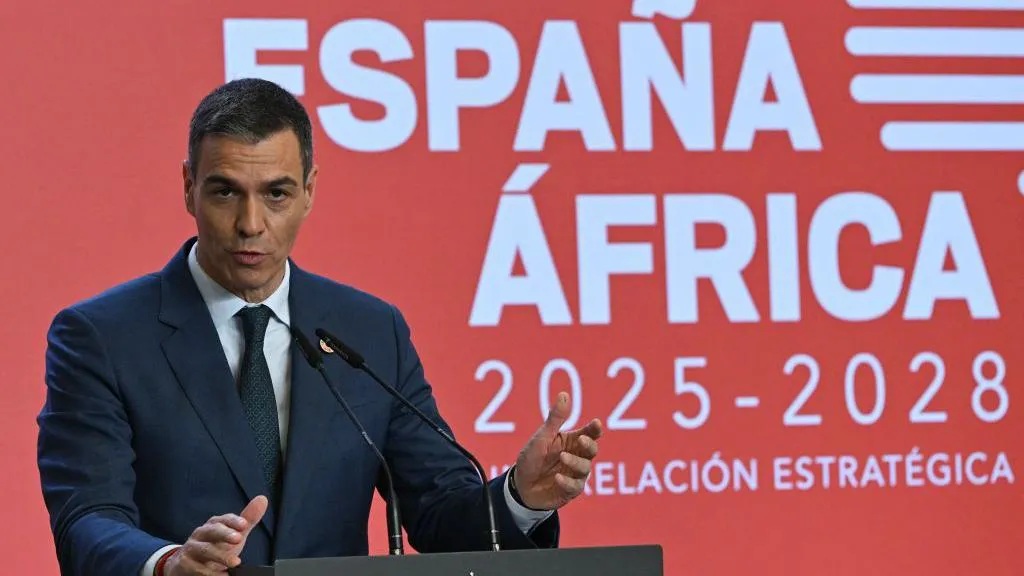
MADRID – Spain is charting a distinct political course by strengthening its commitment to the African continent, a policy that runs against the prevailing trend of cutbacks and hostile rhetoric from other major Western nations including the US, the UK, France, and Germany.
At a time when development aid budgets are shrinking elsewhere, Spain’s socialist-led government is pressing ahead with a planned expansion of its engagement, emphasizing a new tone and a deeper, diversified relationship with its near neighbor across the Strait of Gibraltar.
This week, Madrid hosted the African Union-backed “world conference on people of African descent,” dubbed AfroMadrid2025, which focused on issues of restorative justice and the creation of a new development fund. This event is the latest move to solidify Spain’s commitment.
Foreign Minister José Manuel Albares recently launched a new advisory council—comprising more than half African figures—to monitor the delivery of the detailed Spain-Africa strategy published last year. The plan includes opening new embassies south of the Sahara and fostering partnerships in business and education. The strategic shift is underscored by a 2024-2027 co-operation plan that, for the first time, prioritizes West Africa, including the Sahel, for assistance alongside Central and South America.

Thousands try to make the crossing to the Canary Islands on packed wooden boats
A ‘Rational’ Approach to Migration
The contrast with other European capitals is most stark in the approach to migration. While Prime Minister Pedro Sánchez faces an electoral challenge from the radical right Vox party—which routinely ranks third in opinion polls based partly on anti-immigrant sentiment—his government is moving away from the “hostile messaging” prevalent elsewhere.
Sánchez openly acknowledges the “hard economic realities” in West Africa that compel people to undertake perilous journeys to Europe. Instead of simply rejecting arrivals, Spain is focusing on “mutually beneficial” and “safe, orderly and regular” movements of people.
In a recent trip to Mauritania, Sánchez stressed the crucial economic contribution of migrants to the Spanish economy, stating, “the migratory phenomenon is not only a question of moral principles, solidarity and dignity, but also one of rationality.”

Spain’s Prime Minister Pedro Sanchez (R) met Mauritania’s President Mohamed Ould Ghazouani (L) in Madrid last year
Creative Solutions and Political Pressure
In 2023, more than 45,000 people made the dangerous sea crossing from Africa’s west coast to the Canary Islands, with tragically high death estimates ranging from 1,400 to over 10,000. Spain has to manage the intake and integration of all new arrivals, whether via the Canary Islands, the Straits of Gibraltar, or the North African enclaves of Ceuta and Melilla.
The government is countering the crisis with pragmatic programs, including:
Funding training schemes for unemployed youth in countries like Senegal to create viable livelihoods back home, particularly for returned irregular migrants.
Expanding “circular migration” programs with nations like Senegal, Mauritania, and The Gambia, offering short-term visas for seasonal work, primarily in agriculture, followed by a mandated return.
The political sensitivity of migration was highlighted in July when extra security was deployed in Torre Pacheco, Murcia, following an incident involving Moroccan workers, to which the hardline Vox party responded by demanding a crackdown on immigrants in less-skilled, economically crucial jobs.
Despite the domestic political pressure, the foreign ministry’s strategy heavily emphasizes supporting the African diaspora, the fight against racism and xenophobia, and backing democratic institutions like the African Union and the embattled West African regional bloc, Ecowas.