Darwin, 11 September – After six and a half long years, elections were finally held for the Dhaka University Central Students’ Union (DUCSU). Since independence, DUCSU has been closely linked with important historical events in the country. The Language Movement of 1952, the Six-Point demand of 1966, the Mass Uprising of 1969, and the Liberation War of 1971—all bore the extraordinary role of DUCSU.
After effectively lying dormant since the 1990s, the last DUCSU election was held in 2019. Now, six and a half years later, the 38th DUCSU election has taken place.
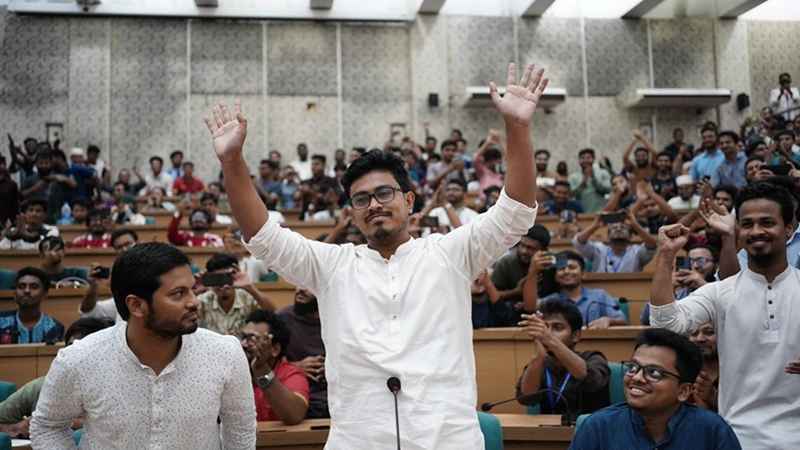
In Tuesday’s election, the highest number of candidates in history contested, with nearly forty thousand students voting simultaneously. With oversight from the university’s proctorial team along with police, RAB, BGB, and the national intelligence agency, the election was conducted in a fair and peaceful environment.
After counting the votes, the winners were announced. The panel supported by Islami Chhatra Shibir, the student organization that had opposed Bangladesh’s Liberation War, under the banner “United Students’ Alliance,” won 23 out of 28 posts in DUCSU. Sadiq Kayem was elected VP, S. M. Farhad as GS, and Mohiuddin Khan as AGS.
On the other hand, the panel backed by Bangladesh Jatiyatabadi Chhatra Dal failed to achieve the expected results. They lagged behind the winning panel by nearly double the votes.
The public victory of Chhatra Shibir—despite not being allowed to do open politics at Dhaka University—has surprised many. Analysts believe that years of organizational strength, political strategy, financial capability, and continuous welfare work for students made this outcome possible. Divisions among Chhatra Dal and other groups, memories of past repression, and a sense of security among voters also played a vital role in Shibir’s win.
Dr. Snigdha Rezwana, Professor of Anthropology at Jahangirnagar University, said:
“I don’t think this victory of Shibir in DUCSU is a sudden or accidental event. It was actually predictable. Over the past 10–15 years, their influence and presence at Dhaka University have grown significantly. One reason is that around 2010–2011, the then government instructed that 10–20 percent of DU’s student intake come from madrasas in the name of inclusion. As a result, a huge number of madrasa students gained admission. And the admission test system is outdated and rote-based, which benefitted them. This also happened in medical colleges.
Another issue is that in recent years, topics like veil, hijab, or burqa have been politicized to create confrontational attitudes. Even biometric registration was introduced as a political issue in educational institutions, which was not the case earlier. The previous government tried to instill fear using this issue. This shifted focus away from the rise of right-wing forces. From this environment, today’s DUCSU result became possible.”
According to her, “This victory will surely have consequences. First, Shibir has achieved a major public success at DU for the first time. They had many hidden successes before. Now, the kind of campaign that brought them victory at DUCSU could very well be used in national elections. Also, a cultural battle has begun in the country. For those still fighting separately, DUCSU has created a backdrop to unite.”
Dr. Sabbir Ahmed, Professor of Political Science at Dhaka University, said:
“In this DUCSU election, others created an anti-Shibir narrative. On one side was Shibir, and on the other side was anti-Shibir. But those who tried to push this anti-Shibir narrative were divided into multiple panels. Shibir saw DUCSU as the outcome of the ‘24 Uprising and used that canvas.
Meanwhile, others campaigned saying, ‘Shibir opposed independence, don’t vote for them.’ But voters didn’t accept this direct appeal. This was a battle of narratives. Others couldn’t use the ‘24 Uprising canvas effectively. From candidate selection to strategy, Shibir was ahead. Their long-term strategy has borne fruit. Shibir and Chhatra Dal have also been long oppressed, which gained them sympathy. But Shibir didn’t remain idle during that time—they expanded their organization in new ways and grew stronger.”
He added, “Since Shibir didn’t have open activities at DU before, it was difficult to campaign against them directly. However, the 2002 incident where Chhatra Dal attacked Shamsunnahar Hall was widely recalled among female students.”
Former DUCSU GS Mushtaq Hossain observed:
“Not all who voted for Shibir did so out of ideological support. Many voted out of fear of dominant, occupying student politics. They had seen extortion and violence from other student organizations in the past. Shibir didn’t have such a record at DU. Also, they played a significant role in the ‘24 Uprising. Distrust among the student organizations opposing Shibir also gave them an opening.
But if Shibir now tries to impose anti-Liberation stances or rehabilitate collaborators (Razakars), these very students will reject them.”
Journalist and analyst Masud Kamal also believes students voted for Shibir to avoid the return of oppressive student politics. He said:
“Students thought if Chhatra Dal won, they would establish domination like Chhatra League, bringing back ‘guestroom culture’ and oppression. Shibir candidates had a better image. On the other hand, arrogance and haughtiness had grown within Chhatra Dal, which students noticed. This election result was a response to that.
Another factor: After 5 August, who filed most of the cases and carried out attacks against Awami League and Chhatra League? BNP, along with Chhatra Dal and Jubo Dal. Their children study at DU. And even though Chhatra League was banned, their voters still exist. Except at Jagannath Hall, Chhatra League votes largely went to Shibir. Women’s hall votes suggest the same. They felt Shibir was safer. However, minority voters did not feel secure with Shibir—the Jagannath Hall result proves that.”
Political analyst Ashraf Kayser commented:
“Chhatra Dal failed because they clung to old politics without focusing on student rights. Shibir emphasized student rights. They have long worked for student welfare—running coaching centers, hostels, and helping students in many ways. Thus, students overlooked their anti-Liberation stance and valued their welfare work. That paid off.
This also reveals what kind of leaders young people want. That aspiration will be reflected in national politics. Similar trends may be seen in upcoming student union elections at Jahangirnagar (JUCSU), Rajshahi (RUCSU), Chittagong (CUCSU), and other public universities.”
Source: Deutsche Welle