Darwin, 13 November-
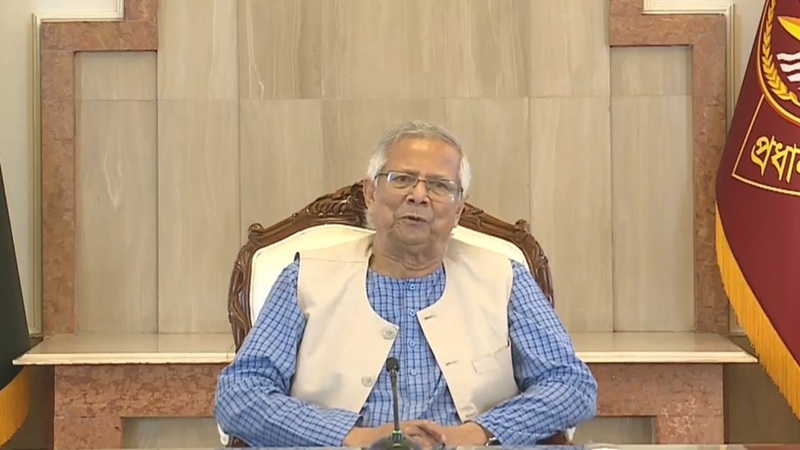
Bangladesh’s Chief Adviser Dr. Muhammad Yunus has announced that the national parliamentary election and a national referendum on the “July Charter”—a proposed constitutional reform framework—will be held on the same day.
In a televised address to the nation on Thursday afternoon, Yunus reaffirmed that the general election will take place in the first half of February 2026, though he did not specify the exact date.
> “We have another great responsibility ahead of us—the fair conduct of the national election,” the Chief Adviser said. “All preparations are underway to ensure the election is festive, participatory, and peaceful.”
Yunus revealed that the Advisory Council has approved the July National Charter (Constitutional Reform) Implementation Order, 2025, calling it a “historic development.” The order is now awaiting official gazette publication.
Referendum to Coincide with Election
Dr. Yunus stated, “After careful consideration, we have decided that the referendum on the July Charter will be held on the same day as the national election—that is, in the first half of February.”
This move aligns with the Bangladesh Nationalist Party (BNP)’s long-standing demand, though the Jamaat-e-Islami had earlier called for the referendum to be held by November before any election takes place.
Yunus argued that holding both votes simultaneously would make the process “more festive and cost-effective” and would not obstruct the broader reform agenda. Necessary legislation for the referendum will be enacted in due course, he added.
The Referendum Question
The ballot will ask citizens a single question:
> “Do you approve of the July National Charter (Constitutional Reform) Implementation Order, 2025, and the constitutional reform proposals contained in the July National Charter?”
The question includes four key points:
1. A caretaker government, Election Commission, and other constitutional bodies will be formed according to the processes outlined in the July Charter.
2. The next parliament will have two chambers, with a 100-member upper house elected proportionally based on votes received by each party. Constitutional amendments will require a majority vote in the upper house.
3. The reforms will ensure greater representation of women, a deputy speaker and parliamentary committee chairs from the opposition, prime ministerial term limits, expanded presidential powers, enhanced fundamental rights, judicial independence, and stronger local governance—in line with 30 reform proposals agreed upon by political parties.
4. Other agreed reforms in the July Charter will be implemented according to political commitments.
Voters will express approval or rejection by casting a ‘Yes’ or ‘No’ vote.
If the “Yes” vote prevails, a Constitutional Reform Council will be formed with elected representatives, who will also serve as members of parliament. The council will have 180 working days to draft constitutional amendments, after which an upper chamber will be established within 30 days based on the proportional representation of votes.
“A Critical Turning Point”
Calling this period a “critical juncture,” Yunus said, “Our government had three primary responsibilities: ensuring justice for the killings during the July Uprising, preparing institutional reforms for a democratic transition, and transferring power through free and fair elections.”
He noted that the International Crimes Tribunal investigating the July Uprising killings is nearing its first verdict, with several other cases close to conclusion. Ordinary courts have also begun trials related to the killings and enforced disappearances for the first time in Bangladesh’s history.
The interim government, he said, has achieved “substantial progress” on institutional reforms—including judicial independence, transparency in the financial sector, digitalization, institutional strengthening, and anti-corruption measures—through ordinances and amendments to existing laws.
Broad Political Consensus
Yunus dismissed speculation of deep political rifts, emphasizing that the National Consensus Commission’s 30 constitutional reform proposals have received broad agreement across political parties.
> “Some prefer to enshrine reforms in the constitution, others through legislation—but there is no disagreement on the necessity, principles, or objectives of reform,” he said. “The differences are procedural, not ideological. This unity gives the nation confidence to move forward.”
Economic Stability Returns
Reflecting on the 15 months since his government took office following the August 8, 2024 uprising, Yunus claimed Bangladesh’s economy had “recovered from a deep crisis.”
> “Exports, foreign investment, and reserves have all rebounded,” he said. “The looted banking sector has been revived, and public confidence restored. Multiple reforms are underway to further strengthen it.”
He added that foreign direct investment (FDI) rose 19.13% in the first year after the uprising—defying global trends—and that Bangladesh will soon sign a $550 million investment deal with the APM Terminals B.V., a subsidiary of Denmark’s Maersk Group, to develop the Laldia Container Terminal, the country’s first world-class “green port.”
> “This will be the largest single European investment in Bangladesh’s history,” Yunus said.